"Mia," Loretta said, low and sharp. The bailiff's voice. Thirty-one years of it.
The girl stopped in the middle of the aisle.
The judge had looked up. The bailiff by the bench, a heavy young deputy, had taken a step forward. Dale Voss's lawyer half rose from his chair.
Loretta stood up, set Hazel gently in Noah's lap, and walked down the aisle. She put her hand on Mia's shoulder. She did not pull her back. She just stood beside her.
"Your Honor," Loretta said. "I'm the foster placement. Loretta Fry. I apologize for the interruption."
Judge Hollis looked down at them over her glasses.
"Mrs. Fry. Does the young lady have something she wishes to tell the court?"
"I believe she does, Your Honor," Loretta said. "But not here. Not in front of him."
The judge was quiet for a long moment.
Loretta knew what she was weighing. She had stood next to judges like Hollis for three decades. A good judge did not want a child testifying in open court against a relative. But a good judge also wanted to hear from the child.
"Mrs. Fry," the judge said. "Are you familiar with in-camera interviews?"
"I stood outside the door of about four hundred of them, Your Honor. Cuyahoga County Juvenile. 1993 to 2024."
Something changed in the judge's face. Not much. Just a little.
"The guardian ad litem will bring Mia to my chambers at eight-thirty tomorrow morning," Judge Hollis said. "Counsel may submit questions in writing. We're adjourned."
That night, after the children were asleep, Loretta sat at her kitchen table with a cup of coffee and a yellow legal pad and thought.
Dale Voss's lawyer had said Dale owned his own home and had steady work. He had said it very smoothly. Too smoothly. Thirty-one years in a courtroom had taught Loretta one thing above all others. When a lawyer says something fast and moves right along, that is the part to look at.
She did not have a computer. She had never needed one. But she knew exactly where a county keeps the truth about a man.
At eight o'clock the next morning, while the guardian ad litem drove Mia to the courthouse, Loretta was standing at the counter of the Calder County Clerk of Courts on the first floor, with Hazel on her hip.
"Public docket search, please," she said. "Civil and probate. Last name Voss. First name Dale."
The clerk was an older woman with reading glasses on a chain. She looked at Loretta, and at Hazel, and smiled.
"You've done this before," she said.
"Once or twice," Loretta said.
It took the clerk eleven minutes.
Dale Voss did not own his home. There was a foreclosure case on it, filed in August, with a sheriff's sale scheduled for January. There were two judgments against him from credit card companies, unpaid. There was a small claims case from a cattle hauler who said Dale owed him four thousand dollars.
And there was one more thing.
On the probate side, filed eight days ago, two days after Amanda Ritter's funeral, was an application by Dale Voss for authority to sell real estate belonging to the estate of Amanda Ritter. A small farm off Lutz Hollow Road. He had listed himself as next of kin and proposed guardian.
He had filed to sell the children's farm before the court had even decided who would raise them.
Loretta asked for certified copies. She paid for them in cash. Then she called Sheriff Earl Whitaker, who was in the courthouse hallway upstairs, and said, "Earl, help me understand something. Can you get these to the guardian ad litem in the next twenty minutes?"
"Loretta," Earl said, "I can get them there in five."
Mia came out of the judge's chambers at nine-fifteen. Her eyes were red. Her chin was up.
She sat down next to Loretta in the second row and did not say what she had told the judge. Loretta did not ask.
The guardian ad litem stood up at nine-thirty and handed the certified copies to the judge and to both lawyers.
Dale Voss's lawyer read them. His face did not change, but he turned slowly in his chair and looked at his client for a long time.
Dale did not look back. He was staring at the table.
Judge Hollis read every page. Then she took off her glasses.
"Mr. Voss," she said. "Is there anything you would like to tell the court about these filings?"
Dale's lawyer started to stand. Dale put a hand on his arm.
"No, ma'am," Dale said quietly. "I guess there isn't."
The judge appointed Jess and Luke Miller as guardians of all three Ritter children. She ordered the life insurance placed in a restricted account for the children, to be released only by the court. The farm on Lutz Hollow Road would stay in the estate until Mia turned eighteen.
She also said, in a clear voice, for the record, that a veteran's history of seeking treatment was evidence of good judgment, not bad, and that the court would not consider it against her.
Jess Miller cried then. Just for a moment. Luke held her hand.
Dale Voss was waiting on the courthouse steps when Loretta came out with the children. He was smoking a cigarette with shaking hands. His new tie was loose.
The children stopped. Loretta did not.
She walked right up to him.
"I owe a lot of people money," Dale said, before she could speak. He did not look at her. "I thought if I got the farm, I could sell it, pay them off, and put the rest away for the kids. I wasn't going to steal from them. I was going to borrow."
"I've heard that in court before," Loretta said. "About three hundred times."
He nodded slowly. He looked very tired.
"You're her uncle," Loretta said. "That doesn't stop being true because you did a foolish thing. Hazel's birthday is March fourth. The Millers are having it at their farm. If you come sober and on time and don't ask anybody for a dime, I expect they'll let you in."
Dale looked at her for the first time.
Then he looked past her at Hazel, who was four and had no idea who he was, and who was staring at him with great interest from Loretta's hip.
He put out his cigarette on the step, picked up the butt, and put it in his pocket.
"March fourth," he said.
The Ritter children moved to the Millers' farm on Creek Road the week before Christmas. Loretta helped them pack.
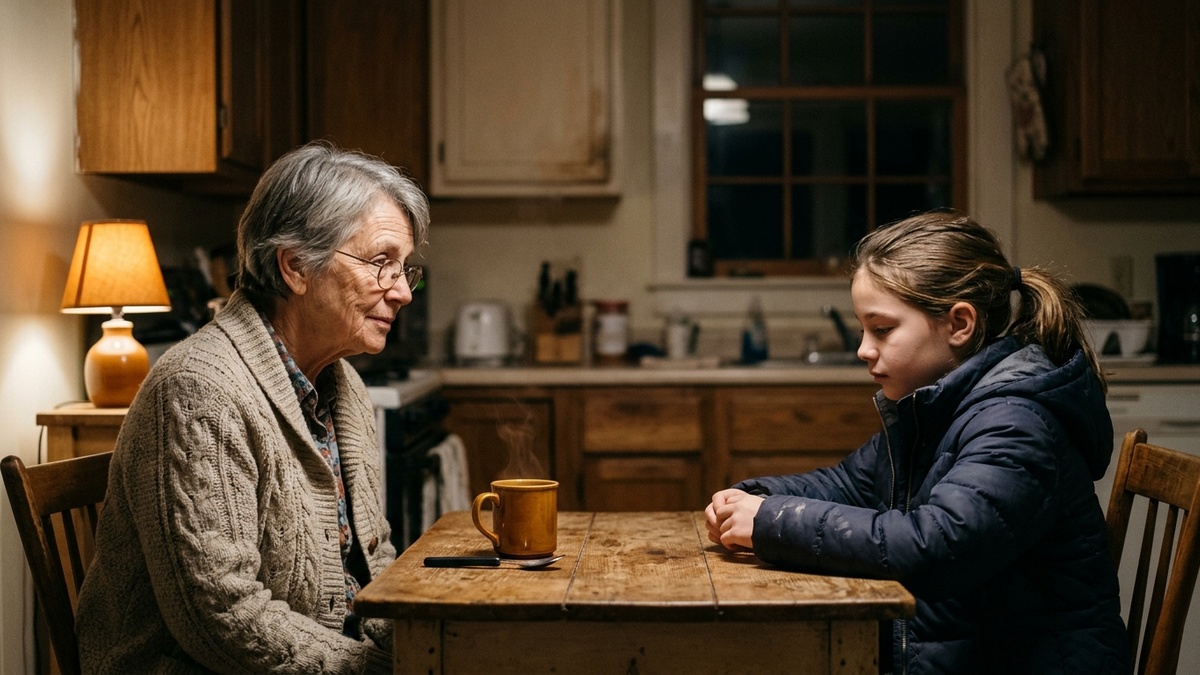
On the last night, Mia came into the kitchen in her pajamas and sat down across the table from her, the way she had the first night.
"Were you really a bailiff for thirty-one years?"
"I was."
"Did you ever get to say anything? In court?"
Loretta thought about it.
"All rise," she said. "That was about it."
Mia almost smiled. Then she reached into her pocket and set something on the table between them. Her mother's car keys.
"Will you keep these?" she asked. "Just until I'm sixteen. I don't want to lose them at a new house."
Loretta picked up the keys. She held them for a while.
"I'll keep them," she said. "Right here. The way I kept the door."