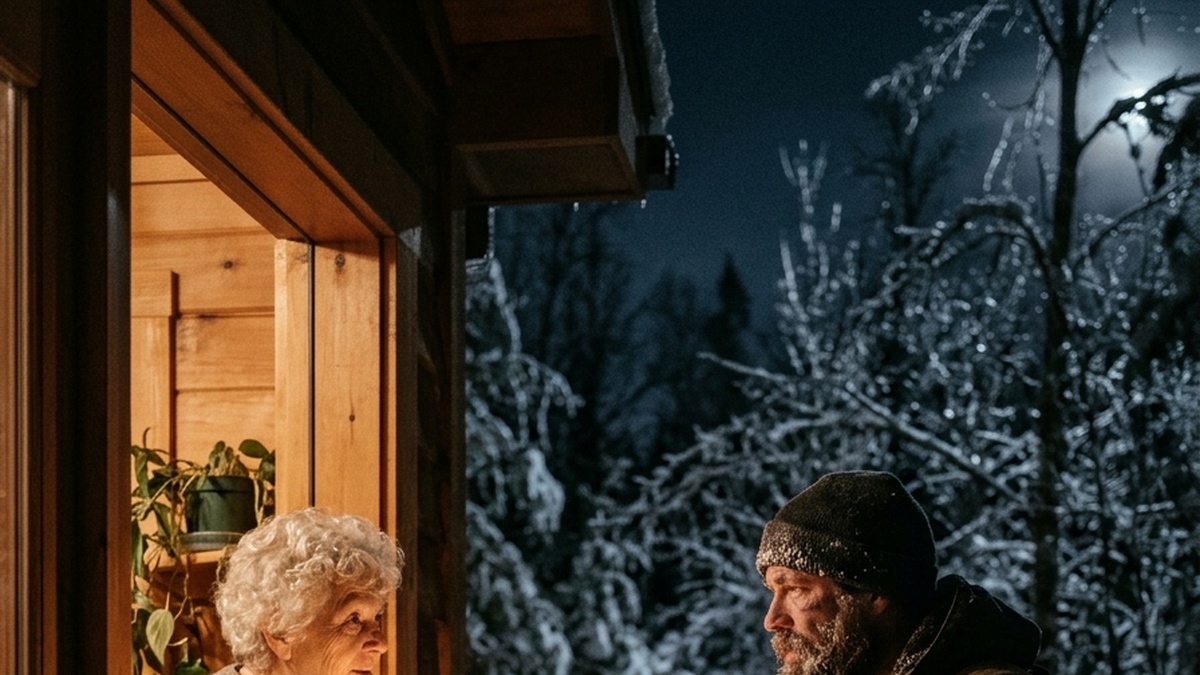
"Wes," Opal said. "The door."
He did not ask what she had seen. He looked at her face once and stepped back and put his shoulder into the door. It was an old door with an old lock. It went the second time.
The cold inside the house was the first thing Opal noticed. It was nearly as cold as the porch. The thermometer on the wall by the kitchen said thirty-eight degrees.
She was on her knees beside Floyd before she had thought about it. Thirty-nine years of nights in the emergency room did that for her. Her hands knew what to do before her head caught up.
"Floyd. Floyd, it's Opal. Open your eyes for me."
He was breathing. His skin was cold and gray, but he was breathing. When she pressed his shoulder, his eyelids moved.
"Opal," he whispered. "I fell."
"I know you did, honey. We're going to get you warm."
She checked him the way she had checked a thousand people on a thousand cold nights. His hip seemed sound. He could squeeze her hand with both of his. He had a goose egg on his forehead from the edge of the coffee table, but his eyes followed her flashlight, and he knew what day it was.
He had been on the floor almost three hours.
"We can't stay here," she told Wes. "There's no heat, and we can't wait for an ambulance in this. My house is warm. Can you carry him?"
Wes looked at Floyd. Floyd was a small man, and the cold had made him smaller.
"Yes, ma'am," he said.
They wrapped Floyd in every blanket on his bed. Wes lifted him the way you would lift a sleeping child, careful of his head. Opal went ahead with the flashlight this time, calling back every rough patch of ice and every fallen branch.
It took them thirty minutes to get back down Creek Road. Wes did not stop once.
Opal laid Floyd on her couch, close to the woodstove. She warmed him slowly, the way she had been trained, with blankets and warm sweet tea a sip at a time, talking to him the whole while. She called his daughter back on the landline and held the phone to his ear so his daughter could hear his voice.
Then she called the sheriff's office. Earl Whitaker said the road was blocked by three trees and the ambulance couldn't get through until the county trucks cleared it, probably by dawn. He asked if Floyd was safe where he was.
"He's safe," Opal said. "He's with a nurse."
By three in the morning, Floyd had color in his face and was complaining that her tea was too sweet. By four, he was asleep, snoring softly, with his hand in Opal's.
Wes sat at the kitchen table across from the stove with his coat still on. He had not slept either.
"You've done this before," he said quietly.
"For thirty-nine years," Opal said. "In Marietta."
He was quiet for a long time. Then he held out his right hand, palm up, in the lamplight.
"1983," he said. "December. I was fourteen. I'd run off from a bad house in Belpre and I broke a window to get into a warehouse to sleep, and I cut my hand open on the glass. A security guard brought me in. The nurse who stitched me up wore a little gold butterfly pin on her collar."
Opal sat very still.
"The others in that room wanted to call the county," Wes said. "She sat with me two hours. She asked me if I had anybody. I said an aunt in Kentucky. When her shift was over, she drove me to the bus station herself and bought my ticket and gave me forty dollars." He looked at his palm. "I never knew her name. I looked for her for forty years. I'd drive past that hospital every time I hauled through Marietta."
Opal reached up, without thinking, to the collar of her sweater. There was nothing there. The butterfly pin had been her mother's. She had worn it every night shift from 1972 until 2011, when the clasp finally broke.
"It's in my jewelry box," she said. "Upstairs."
Wes looked at her.
Then he put his face in his big scarred hands and cried, as quietly as Floyd snored.
The county trucks cleared Creek Road at seven. The ambulance took Floyd to Marietta, grumbling, and the doctors said he would be home by Christmas. Earl drove Wes up Route 9 to his truck and pulled it out of the ditch with a chain.
Before he left, Wes stood on Opal's porch in the gray morning light.
"I owe you forty dollars," he said. "With forty years of interest."
"You don't owe me a thing," Opal said. "You carried Floyd Eckert a quarter mile on the ice. I'd say we're square."
He smiled at that. He did not argue.
She found the envelope in her sugar bowl that afternoon, when she went to make tea. Inside were four hundred dollars and a note on the back of a fuel receipt, in careful, blocky handwriting.
For the next kid. W.K.
On Sunday, Opal put the envelope in the Grace Methodist offering plate with a note of her own, asking Pastor Greer to keep it for any young person who came through Pine Hollow with nowhere to go.
Then she went home, climbed the stairs, and found the gold butterfly pin in her jewelry box. The clasp was still broken.
She took it to Walt Brenner, who looked at it for a long while, said nothing at all, and fixed it in ten minutes with a pair of jeweler's pliers. She pinned it to her collar the next morning before church, right where it had ridden through thirty-nine years of night shifts.